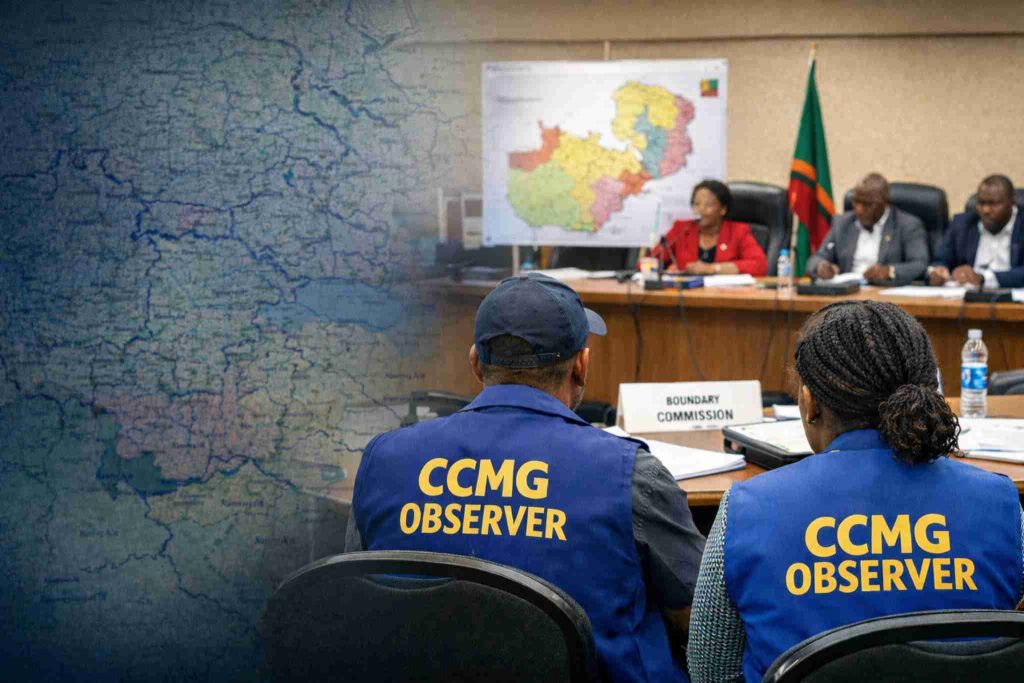
The Christian Churches Monitoring Group (CCMG) deployed 116 observers to monitor boundary delimitation sittings conducted by the Electoral Commission of Zambia (ECZ) across all 116 districts of Zambia. Boundary delimitation is a constitutionally significant electoral process and should be guided by the fundamental principles of impartiality, equality, representativeness, non-discrimination, transparency and inclusivity. Each observer was stationed at a district delimitation sitting to assess compliance with these key principles. District delimitation sittings are followed by provincial level sittings, and stakeholder submissions are to be gathered, reviewed and used in the final delimitation report recommending the delimitation of new Constituencies. In the past, the process has not met transparency standards and the failure to release the 2019 Boundary Delimitation report and to demonstrate how constituency boundaries are ultimately decided has generated controversy and reduced confidence in the electoral process.
While the Constitution provides broad guidance on delimitation, taking into consideration the history, diversity and cohesiveness of the constituency, both the Constitution and international best practice stipulate that constituencies should “achieve an approximate equality of constituency and ward population.” This preserves the principle of“equality of the vote,” or the principle of equal suffrage, which demands that all votes count equally. Based on CCMG’s analysis, Zambia currently has significant variations in voting power between constituencies, for example Kanyama Constituency with 178,424 registered voters and Lufubu Constituency with 11,440 registered voters[1], both of which have the same number of representatives in parliament despite their vastly different populations.
Based on reports from 116 Boundary Delimitation Observers, CCMG finds that the district boundary delimitation sittings were generally conducted in accordance with established procedures, with sittings held as scheduled and presided over by ECZ officials. Stakeholders were afforded opportunities to make submissions on the proposed creation of seventy (70) new constituencies, and discussions were largely peaceful. Relevant demographic and geographic data were provided to guide deliberations, enabling engagement on population size, administrative boundaries and accessibility considerations.
However, CCMG notes, with concern, the limited time allocated for stakeholder consultations with only one (1) day assigned for district sittings in each of the 116 districts. Considering the electoral implications of boundary delimitation and the associated political sensitivity, this timeframe constrained thorough deliberation, particularly in areas with complex geographic and traditional dynamics. Many stakeholders indicated that additional time was necessary to adequately scrutinize maps, population statistics and proposed boundary adjustments.
Additional concerns include limited circulation of key reference documents such as the 2019 Boundary Delimitation Report, accessibility challenges for persons with disabilities, and uneven participation among political parties and civil society. CCMG reiterates that meaningful consultation, inclusivity and transparency in the electoral process remain essential to sustaining public confidence in critical processes in the leadup to the August 13 general election.
Key Findings
1. Access and Conduct of Sittings
All sittings were held as scheduled by the ECZ. All sittings were presided over by ECZ officials, and council or other government officials were present in all districts observed.
2. Publicity and Venue Conditions
Publicity regarding the time and place of sittings was reported in 91% of districts. Ninety-seven percent (97%) of sittings were held in public venues. However, 12% of venues were reported as not large enough to accommodate all stakeholders. Accessibility for persons with disabilities remains a significant concern with 9% of venues not accessible to persons with disabilities. These findings indicate the need for stronger compliance with inclusive access standards in future electoral processes.
3. Stakeholder Participation
Traditional leaders were present in 96% of sittings, and Members of Parliament attended 82% of sittings. Media presence was recorded in 97% of districts. Representation of political parties varied. Representatives of the United Party for National Development (UPND) were present at nearly all sittings (98%), while participation by other political parties was comparatively lower at 84%. Civil society organizations (CSOs) and faith-based organizations (FBOs) were present in 55% of sittings.
4. Information Provision and Transparency
The ECZ demonstrated procedural transparency during the sittings, including providing and explaining maps of old boundaries, population data and geographic criteria. Additionally, data on citizens-per-constituency ratios and process for submission of stakeholder concerns during sittings were explained. However, reference documents such as the 2019 Boundary Delimitation Report and the Electoral Reform Technical Committee (ERTC) report were only shared in 12% and 16% of the sittings respectively. Greater access to these documents would support more informed stakeholder engagement, particularly considering the government’s indication that they would inform, or at minimum guide, boundary delimitation considerations.
5. Criteria for Delimitation
The size of the total population was the most frequently discussed criterion (76%) in the consideration of new constituencies. While population equality is a foundational principle in electoral boundary delimitation, anchored in the doctrine of equal suffrage and the “one person, one vote” principle, it should not be considered in isolation. Beyond total population figures, CCMG notes that the use of Voting Age Population (VAP) data strengthens representational equity by reflecting the segment of the population legally eligible to vote.
Critical Incidents
During CCMG’s observation of the district boundary delimitation sittings, CCMG documented two (2) critical incidents detailed below:
- On 17 February, CCMG’s observer in Kasempa District reported a disruption at the delimitation sitting held at Comfort Lodge following an unresolvable disagreement among stakeholders regarding proposed constituency boundaries. The meeting concluded prematurely, and discussions were deferred to the provincial sitting scheduled for late February/early March.
- On 19 February, CCMG’s observer in Chongwe District reported an incident of violence at the sitting held at Graka Lodge. A group of UPND cadres, reportedly transported from Lusaka, clashed with Chongwe-based UPND cadres. Stones were thrown, and one UPND member sustained a cut to the face. No arrests were reported.
CCMG strongly condemns all forms of violence and disruption in electoral processes. Boundary delimitation is a technical and consultative exercise that must be conducted in a peaceful and orderly environment.
Conclusion
CCMG’s observation of the district boundary delimitation sittings indicates that the Electoral Commission of Zambia conducted the process with a generally high level of procedural transparency at the sittings and openness to observation. Access for observers was consistently granted, most sittings were held as scheduled, and key technical information, such as population data, maps of existing boundaries, and citizens-per-constituency ratios, was widely presented.
However, the observation also identified areas requiring improvement. These include inconsistent access to foundational reference documents (including the 2019 Boundary Delimitation Report), limited participation by some political parties and civil society actors, accessibility gaps for persons with disabilities, and isolated incidents of disruption and violence. Additionally, while total population was widely referenced, key technical considerations, such as Voting Age Population data and clearly defined permissible deviation thresholds, were not consistently emphasized.
Given the constitutional significance of boundary delimitation and its direct implications for equal suffrage and representational equity, it is essential that subsequent stages of the process strengthen inclusivity, technical rigor, and public confidence.
Recommendations to Key Stakeholders
1. Electoral Commission of Zambia (ECZ)
- Enhance Document Transparency and Accessibility: Proactively publish and distribute key reference materials, including the 2019 Boundary Delimitation Report and the ERTC Report, to stakeholders in advance of consultations to facilitate informed participation.
- Strengthen Technical Procedures and Transparency: The ECZ has not provided guidance to the public on how stakeholder submissions and technical considerations will be weighed in producing the final constituencies. The ECZ should do so, and clearly articulate the use and weight of data in guiding delimitation, including permissible constituency population deviation. Where feasible, incorporate Voting Age Population (VAP) data into constituency assessments.
- Improve Accessibility Standards: Ensure all venues for public consultations are fully accessible to persons with disabilities and sufficiently spacious to accommodate anticipated stakeholders.
- Broaden Public Engagement: Strengthen advance publicity mechanisms to ensure all stakeholders, including CSOs, FBOs, political parties, and marginalized groups, are adequately informed and encouraged to participate.
- Conflict Prevention Measures: Coordinate with law enforcement and local leadership to safeguard peaceful proceedings during future sittings, particularly at provincial-level consultations.
2. Political Parties
- Promote Peaceful Participation: Refrain from mobilizing supporters in a manner that may intimidate stakeholders or disrupt proceedings. Party leadership should reinforce internal codes of conduct emphasizing non-violence and respect for institutional processes.
- Engage Substantively: Focus contributions on evidence-based submissions grounded in demographic, geographic, and legal criteria rather than partisan considerations.
3. Civil Society Organizations and Faith-Based Organizations
- Increase Participation: Strengthen coordinated engagement in subsequent stages of the process to enhance citizen representation and oversight.
- Undertake Civic Education: Educate communities on the principles of equal suffrage, the technical criteria for delimitation, and the importance of peaceful participation.
4. Zambia Police Service
- Ensure Proportionate Security Presence: Maintain adequate and neutral security arrangements at all sittings to deter violence while preserving an open civic environment.
- Investigate Reported Incidents: Take appropriate steps to investigate incidents of violence and ensure accountability in accordance with the law.