Introduction
The Christian Churches Monitoring Group (CCMG) is a nonpartisan and independent coalition of faith-based organizations that promotes more inclusive, transparent and accountable elections for all. CCMG is comprehensively observing the 2026 general elections. As part of that effort, CCMG employed the process and results verification for transparency (PRVT) methodology and deployed 1,500 stationary observers to a nationally representative sample of polling stations in every province, district and constituency on election day.
In our preliminary statement, CCMG noted that “while there were isolated challenges on Election Day, overall setup, voting and counting procedures were followed and the process was transparent.” Now that the Electoral Commission of Zambia (ECZ) finished announcing presidential results, CCMG is sharing its PRVT findings on the accuracy of the official results with all Zambians.
Methodology
PRVT, previously known as parallel vote tabulation (PVT), is the most sophisticated method of nonpartisan citizen election monitoring. PRVT is a proven methodology that allows nonpartisan citizen observers to accurately and independently verify the official presidential results. As appropriate, PRVTs can increase public confidence in well-run elections or ensure that election results truly reflect the votes cast. PRVTs have been conducted around the world, and across Africa. CCMG previously conducted PRVTs for presidential elections in 2015, 2016 and 2021. The first PRVT in Zambia was conducted in 1991.
PRVT involves deploying carefully selected and highly trained nonpartian monitors to a nationally representative sample of 1,500 polling stations in every province, district and constituency of the country (see Annex 3). CCMG’s monitors arrived at polling stations at 05:30hrs and did not leave until all the ballots were counted and the official results for the polling station were announced and posted. Throughout the day, our
monitors sent in reports on the conduct of voting and counting, as well as the official results for the polling station.
PRVT estimates are entirely based on official polling station results as announced by ECZ polling officials. It should be noted that PRVTs are not exit polls. No one was asked how they voted. PRVT monitors did not count the ballots. Only ECZ polling officials count ballots. PRVT monitors closely observed the counting process and reported on its conduct. Based on official polling station results, PRVTs produce estimated ranges within which the national-level official results must fall. If the official results fall within the PRVT estimated ranges, then it provides independent verification that the results reflect the ballots cast. If the official results fall outside the PRVT estimated range, then it provides systematic information that the results have been manipulated and the PRVT can suggest the true results. However, it is only the ECZ that can declare official election results.
PRVT Findings
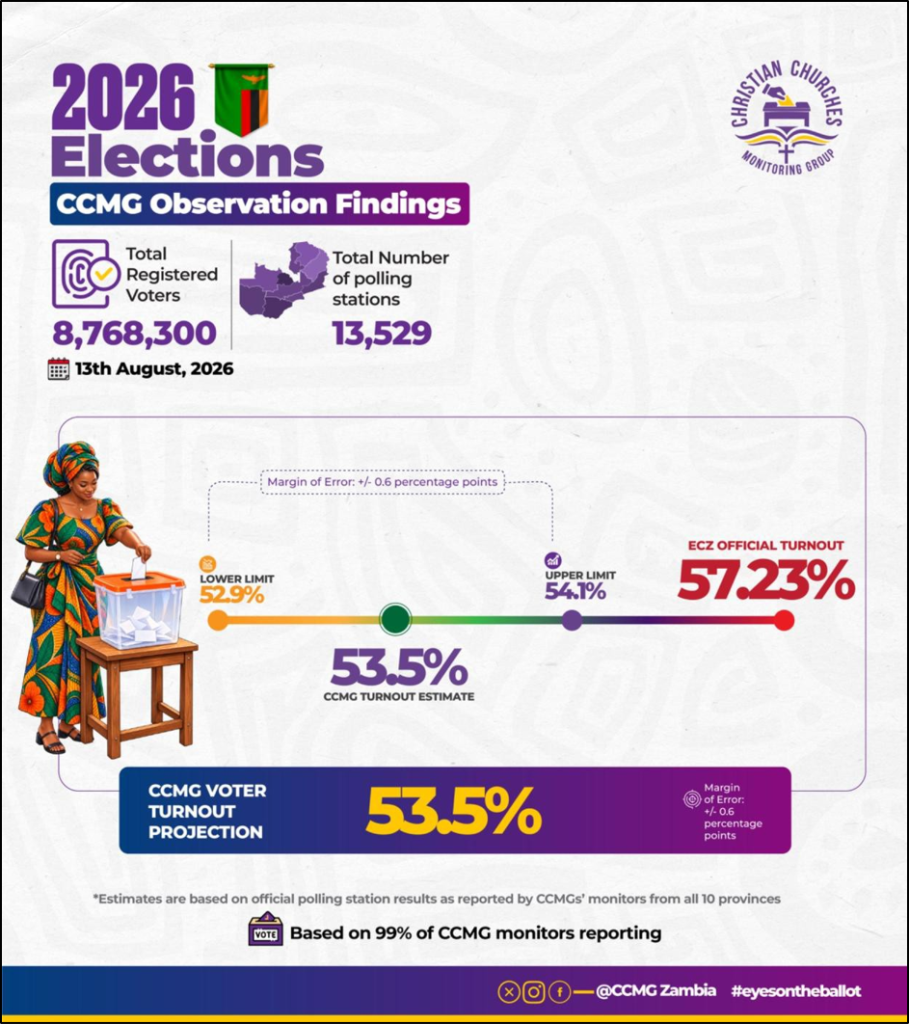
Based on polling station results from 1,491 of 1,500 (99.4%) of sampled polling stations, the PRVT estimates voter turnout at 53.5% +/- 0.6%. This is a significant decrease from 2021 when turnout was 70.6% (see Table 2). PRVT estimates showed lower turnout across the country and therefore we should not expect drastic variances in turnout from constituency-to-constituency, as was reported in some cases by the ECZ.
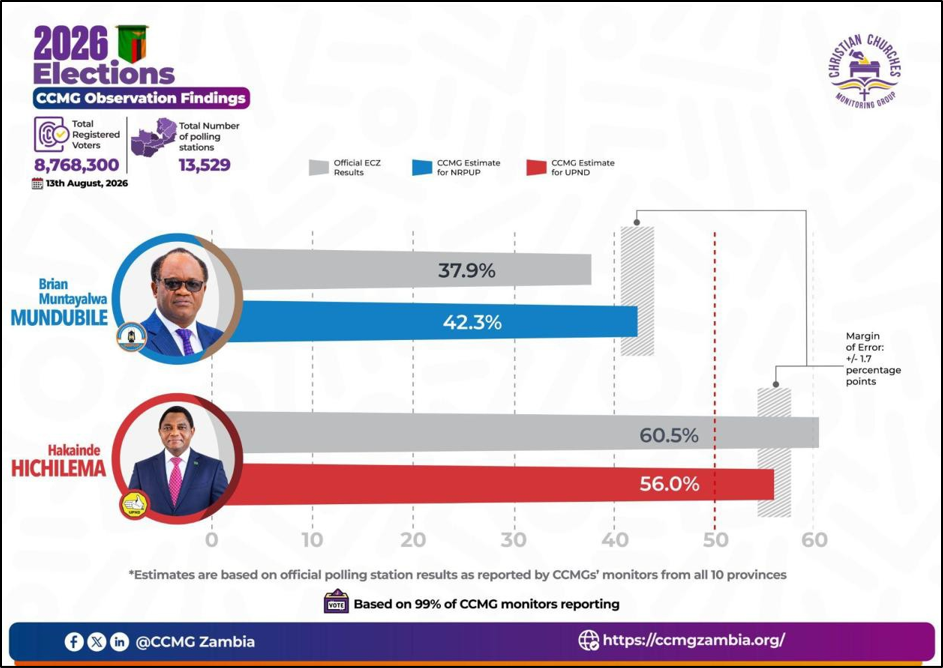
The PRVT estimates President Hakainde Hichilema, United Party for National Development (UPND) will receive 56.0% +/ -1.7% of the vote; Brian Mundubile, National Reconciliation Party for Unity and Prosperity (NRPUP) will receive 42.3%
+/- 1.7% of the vote; and all other candidates will receive at most 0.5% of the vote each. Based on the PRVT estimates, President Hichilema should receive the most votes and more than 50%, thus clearing the threshold for a run-off election. Rejected ballots will be 2.8% +/-0.1%.1
The official results for turnout, President Hichilema and Mundubile do not fall within the PRVT estimated range (see Table 2). This is because in 30 constituencies identified by the PRVT as problematic (see Annex 1), the official turnout is well outside the upper limit (more than 10%) of the PRVT estimate due to increased votes for UPND. For example, for Lusangazi Central the PRVT estimates turnout at 44% +/- 8% with NRPUP receiving 64% +/-9% of the vote and UPND receiving 33% +/-9% of the vote. However, the official results were 66.4% for turnout (12% more than what is plausible) and the voting trend reversed – UPND receiving 51% of the vote and NRPUP 46%. As a result, the official results for turnout and votes for UPND fall well above the PVRT estimated range, and votes for NRPUP fall well below. Results for other parties were essentially unaffected by this issue.
As noted, the PRVT estimates show that turnout will fall significantly across the country from 2021. For the 30 constituencies identified by the PRVT as problematic, the average change in turnout from 2021 was +6% while for the remaining 196 constituencies it was -15%.
The gold standard of electoral transparency is for the election management body to provide polling station level results in a bulk, analysable format according to Open Election Data Principles.2 This allows voters, party agents and election monitors and observers to compare the official results from polling stations with constituency and national results. So far, the ECZ has not systematically provided polling station level results, but observers did receive copies of the “Record of Proceeding at the Totalling of Votes – Presidential” for four constituencies (Kalomo Central, Lufwanyama East, Lufwanyama West and Mongu Central). This allows for official polling station results reported by PRVT monitors to be compared with the polling station level results used at constituency tally centers.
The PRVT included 24 sampled polling stations in the four constituencies (see Annex 3). For 13 of 24 sampled polling stations, all of the results, including rejected ballots, from sampled polling stations matched the results recorded at tally centres.
NRPUP results recorded at tally centres for 1 of 24 polling stations did not match results recorded from sampled polling stations which added 10 votes. UPND results recorded at tally centres for 10 of 24 polling stations did not match results recorded from sampled polling stations with votes for UPND on average 178 votes greater at tally centres than sampled polling stations.
For example, in Kalomo Central constituency3 (Annex 2), the results reported by PRVT monitors for every presidential candidate and rejected ballots from polling stations on election day for three sampled polling stations (Maumbwe Basic School-02, Muchenje Primary School-01, Tara Basic School-01) match the results recorded at the tally centre. However, for Nameto Basic School-01 and Siachitema Secondary School-02, the results for every candidate and rejected ballots matched except votes for UPND—for Nameto Basic School-01, the votes for UPND were increased by 113, and for Siachitema Secondary School-02, the votes for UPND were increased by 170 votes.
Conclusion and Recommendations
The PRVT estimates clearly show that President Hichilema received the most presidential votes and more than the 50% threshold, but it also demonstrates that, for 30 constituencies, votes were added, artificially increasing turnout and undermining the integrity of the process. These observations merit further review, particularly given the implications for the allocation of proportional representation seats. Importantly, however, the variances identified do not alter the overall outcome of the presidential election.
These observations should be addressed transparently through established mechanisms. In order to improve public confidence in the results of all elections and the institution itself, the ECZ should be completely transparent and should immediately make public on its website all 226 “Record of Proceeding at the Totalling of Votes” for both the presidential elections and constituency-based member of parliament elections. The ECZ should also publish images of the GEN20 forms for all 13,529 polling stations.
The ECZ, in consultation with political parties as well as civil society organisations, should determine an appropriate and expeditious way forward to ensure that official results for the presidential election and all 226 constituency-based parliamentary elections reflect the actual ballots cast by voters on election day.
During this period all political parties and candidates should call for calm and take active steps to ensure their supporters conduct themselves peacefully and respect the rights of others. Parties should seek redress through legal processes. The courts should provide as much latitude as possible to avoid dismissing claims on technical grounds so that grievances can be adjudicated transparently.
These have been extremely challenging elections and sharply different from those in 2015, 2016 or 2021. Transparent, inclusive and technically-sound electoral and regulatory reforms will be required to improve Zambia’s electoral processes. All Zambians should come together to restore confidence in our elections and electoral institutions for the good of the country. CCMG calls for all Zambians to remain calm and peaceful. God Bless Zambia!