Introduction
The Christian Churches Monitoring Group (CCMG) is a nonpartisan and independent coalition to promote more inclusive, transparent and accountable elections. As part of our comprehensive monitoring of the 2026 elections, CCMG deployed 1,500 stationary monitors and 156 mobile monitors to every province, district, and constituency on Election Day. We employed the Process and Result Verification for Transparency (PRVT) methodology, previously known as parallel vote tabulation (PVT), to provide the most accurate information on the conduct of election day and to independently verify the accuracy of the official presidential results.
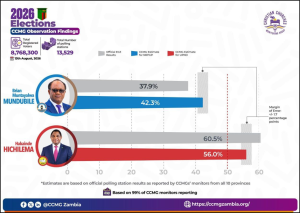
Today, we provide the preliminary findings on the setup of polling stations and conduct of voting and counting based on reports from our monitors across the country. We have received reports from 99% of our 1,500 stationary observers – including over 20,000 reports providing systematic data on setup, voting and counting. We have completed our statistically valid PRVT and will share our PRVT results estimates for the presidential election following the Electoral Commission of Zambia’s release of official results. These estimates will allow voters and political contestants to determine for themselves whether announced results reflect the ballots cast at polling stations on election day.
CCMG recognizes that the process is ongoing and will continue its monitoring effort to enhance transparency and accountability, and will provide a more detailed overall assessment of the 2026 general elections once all processes, including announcement of results and dispute resolution, are complete. CCMG’s monitoring efforts are guided by the Constitution of the Republic of Zambia, the Electoral Process Act, the Electoral Process (General) Regulations and and other laws and regulations which form the legal framework governing elections in Zambia as well as African and international standards for elections. CCMG conducts all its activities in a strictly nonpartisan manner and in accordance with the Declaration of Global Principles for Nonpartisan Election Observation and Monitoring by Citizen Organizations, the standard for citizen election observation.
Election Day Preliminary Findings
Accreditation and Access to Polling Stations
The ability of citizen monitoring organizations to safeguard the electoral process and uphold civil and political rights hinges on the accreditation of their observers in a timely manner and without unreasonable restrictions. Just two months before the elections, the ECZ introduced a new online- only accreditation system requiring individual applications and upload of photos and other documents by monitors. These requirements created undue burdens on election monitoring organizations, especially those mobilizing large numbers of monitors for election day.
The digital system posed serious challenges for monitors with limited access to the internet and devices, potentially undermining their right to participate in the process. While the ECZ ultimately introduced alternative systems, the roll-out was inconsistent and poorly communicated, and still required individual accreditation for monitors, despite the recommendations of election monitoring organizations. Meanwhile, the online system struggled to process the individual digital photos and applications resulting in delays in processing and distributing accreditation for both monitors and party agents. However, CCMG commends ECZ for extending the accreditation deadline to12 August, allowing processing of more applicants, including CCMG’s monitors.
On Election Day, 11 CCMG accredited monitors were prevented from observing, with presiding officers demanding additional documents beyond their ECZ-issued accreditation cards. All monitors were ultimately permitted into polling stations after intervention from CCMG, but reflected the need for greater consistency, training and information for polling officials regarding accreditation procedures and the rights of observers and monitors.
The following data is based on reports from 99% of CCMGs stationary monitors at 1,500 polling stations located in every province, district and constituency of the country. Because they are deployed to a statistical sample, this data is representative of all polling stations.
Setup and Opening of Polling Stations
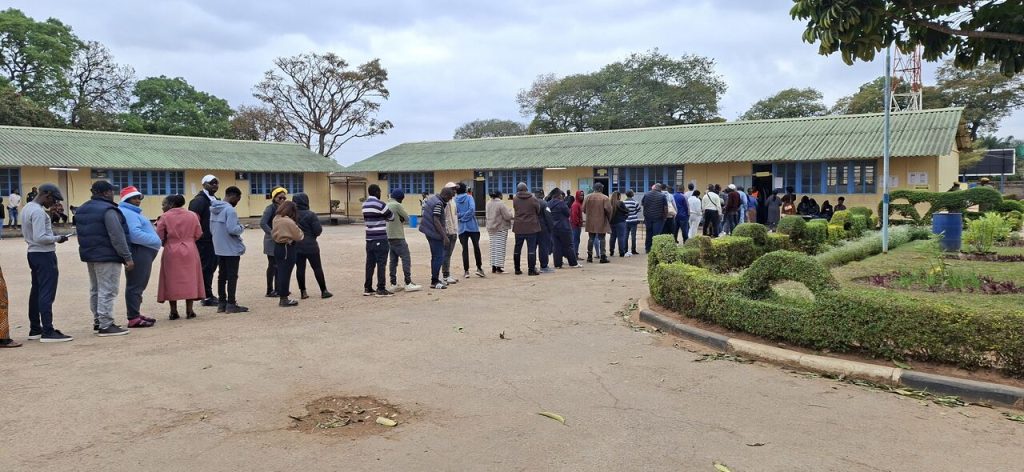
Polling stations generally opened on time, with 96% opening by 7:00hrs with delayed openings largely attributed to the late arrival of materials. Women comprised approximately 50% of polling officials in total; however, only 35% of presiding officers were women. There were security officers present at essentially all polling stations. At opening, United Party for National Development (UPND) had party agents in 99% of polling stations, National Reconciliation Party for Unity and Prosperity (NRPUP) had party agents in 84%, and party agents from any other party were in 79% of polling stations. While this coverage is impressive, it is a decline from 2021, which saw party representatives at 99% of polling stations nationwide for both UPND and PF and 85% for other parties. At 77% of polling stations, voters had to go up some stairs or steps, an important issue for people with disabilities, especially those with physical disabilities, and 69% of stations had Braille Jackets. While the number of polling stations requiring voters to go up some stairs increased from 2021 when it was only 48%, the number of polling stations with Braille Jackets increased from 44%. Essentially, all polling stations had critical election materials such as a permanent marker, the official stamp and a voters’ register. At essentially all polling stations the presidential ballot box was shown to be empty before being closed and sealed.
Voting
At essentially 100% of polling stations, polling officials checked potential voters’ fingers for indelible ink; required potential voters to show both their NRC and Voter ID cards; and checked the names of potential voters in the voters’ register before allowing them to vote. At essentially 100% of polling stations, polling officials stamped the presidential ballot paper before issuing them to voters. At less than 1% of polling stations did polling officials fail to mark a finger of every voter with indelible ink or did some voters put their presidential ballot paper in the wrong ballot box. In order to reduce the barriers to voting, persons with disabilities, pregnant women, nursing mothers and the elderly were allowed to go to the front of the queue at 99% of polling stations.
Very few polling stations experienced challenges during voting, as follows:
- At less than 1% of polling stations there were incidents of individuals being harassed, intimidated or threatened;
- At 1% of polling stations there were women who were subjected to sexual harassment;
- At 8% of polling stations there were five or more men seen voting on behalf of able- bodied women;
- At 1% of polling stations there were five or more individuals appeared to vote illegally;
- At less than 1% polling stations there were five or more eligible voters were turned away and not permitted to vote, however, it was not possible for monitors to know if voters were at the correct polling station;
- At less than 1% of polling stations someone other than a polling official assisted multiple people to vote; and
- At less than 1% of polling stations polling officials or party agents could see how some voters marked their ballots.
Closing and Counting
At the scheduled end of voting, any voters still in the queue were allowed to vote at essentially all polling stations. NRPUP had party agents present at 88% of polling stations, UPND at 99% of polling stations for counting of the presidential ballots. At 81% of polling stations there were party agents from other parties also present during counting. Insufficient light was a problem at 8% of polling stations. To ensure transparency and enhance the accuracy of the count, at 99% of polling stations polling officials showed each presidential ballot paper to all party agents and observers present and at 93% of polling stations the presidential ballot papers were sorted into different piles by candidate. At 7% of polling stations one or more presidential ballot papers were declared as “invalid” despite the voter’s intention being clear and were not counted.
At 1% of polling stations there were incidents of harassment, intimidation while at 2% there were efforts to disrupt the counting process.
At essentially all of polling stations with an NRPUP party agent they agreed with the official result for the presidential election while at essentially all polling stations with a UPND party agent they agreed with the official result. At all polling stations CCMG monitors agreed with the official result while 96% of polling stations polling officials publicly posted the official results.
Critical Incidents
At two polling stations in Kalomo Central Constituency (Mwata Secondary School – 03 and Green Acres Basic School – 01) UPND cadres chased away all election monitors and agents from other political parties, preventing them from observing the counting process.
In Makeni Constituency at John Laing Primary School – 04, unknown assailants armed with offensive weapons such as machetes and bats, stormed a polling station at the point of issuing results forms for the presidential election to party agents.
In Masaiti Constituency, Lisomona Secondary School – 01 polling station initially received the ballot papers for the district council elections for another polling station leading to a delay in opening. Ultimately, the correct ballots were supplied and the polling station was opened.
Conclusion
While there were isolated challenges on Election Day, overall setup, voting and counting procedures were followed and the process was transparent. Though there were some improvements to make processes more inclusive and transparent, significant barriers remain for all Zambians, particularly persons with disabilities, to vote. Of note, while there were concerns before election day about a potential internet disruption on election day, as was the case in 2021, however these fears did not materialize.
CCMG notes that the ECZ has announced that it was suspending counting and announcement of results due to security concerns. Such decisions should be made in consultation with all political parties as well as civil society, including nonpartisan citizen observers, and should serve to enhance security, as well as ensure transparency and accountability. CCMG calls upon the ECZ to maintain open communications with election stakeholders and the nation to reduce political tensions.
As noted, CCMG has completed its PRVT and is ready to independently assess the accuracy of the official results. CCMG will release its PRVT results estimates after the ECZ announces official results. These estimates will allow voters and political contestants to determine for themselves whether announced results reflect the ballots cast at polling stations on election day.
CCMG continues to monitor these elections on behalf of all citizens and will continue our observation effort through the announcement of results and the resolution of any electoral disputes. Once this election cycle is complete CCMG will issue a comprehensive final report that includes not only finding but detailed recommendations aimed at improving our electoral system and processes.
CCMG calls for all Zambians to remain calm and peaceful as we await the announcement of official results.
God Bless Zambia!
Annex: Key Pre-Election Day Issues
Elections are more than a single day event. While CCMG’s PRVT focuses on the quality of the voting, counting, and tabulation processes on election day, these findings should be understood within the broader electoral context, which can impact the rights of voters and political contestants, as well as the inclusivity, representativeness, and efficacy of electoral institutions and systems.
Throughout the pre-election period, CCMG deployed 330 long-term observers (LTOs) across the country, with at least one in every constituency. They reported on electoral preparations; delimitation of constituencies, nomination of candidates; the campaign and political space; the prevalence of political inducements; politically motivated violence and related acts; the use of government resources in campaigning; and partisan acts by traditional and religious leaders, among other issues. For voter registration, CCMG also deployed monitors to a statistical sample of over 1,000 registration centres to monitor the registration process.
Changes to the Electoral Legal Framework: A new legal framework was adopted that, among other provisions, increased the number of constituencies and introduced a new mixed member proportional representation (MMPR) system based on national-level presidential results. However, insufficient consultation and consensus-building around these constitutional amendments and related legislation, and the timing of these changes ran counter to international standards and best practices that discourage significant alterations to election systems and procedures close to the elections to avoid voter confusion and implementation challenges.
Voter Registration: Voter registration was generally conducted according to prescribed procedures and resulted in a final register with 8,786,300 voters including 4,665,431 women, 4,066,423 youth, and 20,162 persons with disabilities. While the Electoral Commission of Zambia’s (ECZ’s) initial projection was to register 3.5 million new voters, they only managed to register 1,762,801. Lack of information and last-minute changes to the registration timeline created confusion for voters and made observation more challenging. CCMG was not provided with a copy of the voters register, making independent analysis of its accuracy and representativeness impossible.
Boundary Delimitation: The 2026 boundary delimitation process was a missed opportunity to use transparent and data-driven criteria to ensure that parliamentary representation is fair, balanced, and reflective of population. CCMG’s analysis found that the delimitation exercise undermined the constitutional principle of equal representation and the international standard of “one person, one vote”.
Political Violence, Intimidation and Disregard for Code of Conduct: Once again violence, including four fatalities, marred the pre-election period – particularly as election day approached. During the campaign period, CCMG observers documented a total of 79 incidents of violence across the country, with the highest number recorded in Lusaka.
Voter Information and Open Data: Open, freely accessible election data enables voters to make more meaningful and informed decisions. This is even more important when there have been fundamental changes to the electoral system. However, critical information was often not made available. For example, the law does not require political parties to submit their lists of candidates for proportional representation seats prior to the election. Further, the ECZ has not released a
detailed boundary delimitation report with population size by constituency information or any details about how voter equality and other criteria were applied when drawing the new constituencies.